
My fake planets now need something that differentiates land cells from each other. Normally, they’d be biomes, but the word “biome” typically implies the type of vegetation. In this simulation, vegetation is not a feature of the planet but rather emerging living species. So, I’ll talk only about climate here, ignoring the impact vegetation has in Earth’s actual climate.
Note that’s “climate” and not “weather”. Since the objective of this project is simulating evolution, its time resolution will be quite course (hundreds of years for each time step, probably), so many things that we see on earth will be irrelevant. Storms, “El Niño”, and even the seasons will be too tiny to be observed in those time scales; only the average temperatures will be important. That’s fortunate, because simulating a remotely believable weather would be a huge project on its own.
Realistic simulations of climate are no piece of cake, either. Models capable of doing so do exist, but they are too sophisticated for a project of this size. Later, however, I would love to at least use some of their principles (one in particular is said to be capable of simulating climate phenomena in the scale of a few months to a few centuries), but I don’t think spending a week reading papers from meteorological societies is the most productive thing I could do right now.
Temperature
‘Cause you’re hot then you’re cold
– Katy Perry correctly points out the cyclical nature of the Earth’s climate
For my super simple climate system, temperature will depend on three variables: the angle at which the sun’s rays impact the surface, the energy received from the sun, and the altitude. The first one, is itself dependent on the angle between the planet’s rotational angle and the plane of its orbit; as well as the planet’s precession movement. The second one depends on the distance from the sun and hence on the shape of the planet’s orbit, but also in fluctuations in the sun’s output due to sun spots or other phenomena. The third depends only on elevation, which has been already solved. Hopefully, all this together will result in something interesting like long-term polar ice caps and mountain glaciers or, if I’m really lucky, cyclical ice ages. To get ice ages, I will probably have to exaggerate some things, but I might be willing to do that since I think they have a super high realism-to-coolness (pun not intended) ratio.
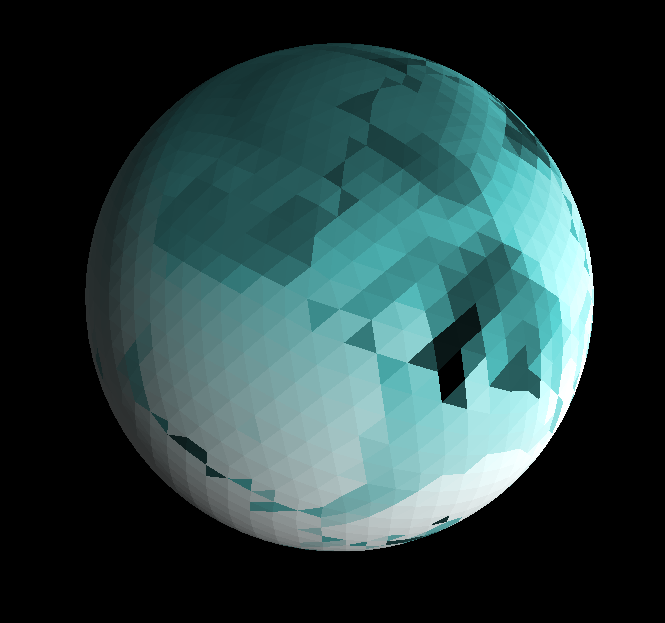
It seems I’ve put too much importance on elevation and not enough on latitude, since the tops of some mountains get much colder than the poles. That’s another factor to tweak later, but for now I’d say it’s working. Temperature will have a great impact on species’ probability of survival in a given area, but also in a more immediate aspect of the planet: its “water” cycle.
“Water” Cycle
In reality, Earth’s water cycle is more complicated than is typically described (for example, saltwater makes its way into the mantle and emerges as vapor from volcanoes, a fact I didn’t know until five minutes ago), but I’ll just go ahead and settle for the more simplified version. “Water” shall evaporate from the oceans, make its way into land and fall as precipitation, flowing back into bodies of liquid water. Some of this water will be held as a “reserve” in that area (by, say, glaciers or aquifers), and some of it will flow to areas of lower elevation forming rivers. Most rivers will probably flow out to the ocean, but if they reach local minima of inland elevation, they will form lakes.
Humidity
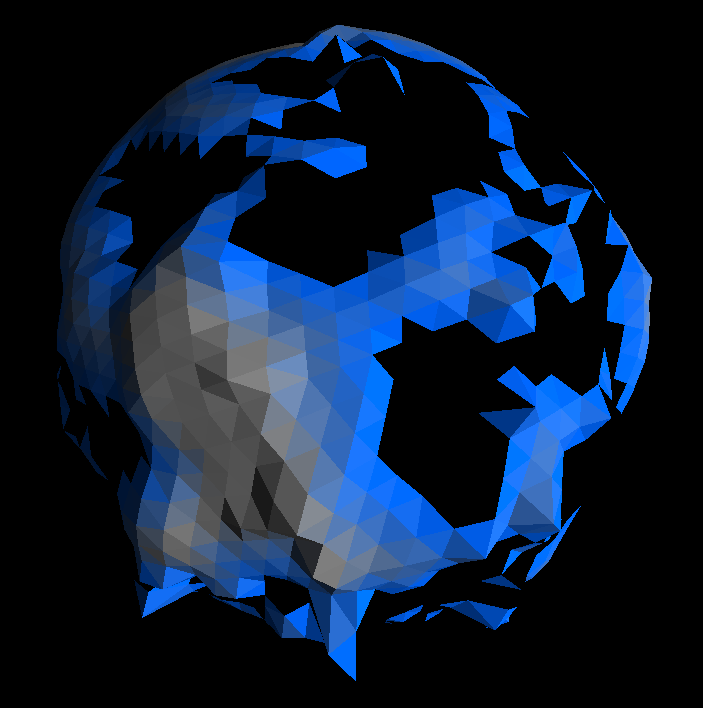
Now, in reality, water is moved as clouds into land by winds. Trying to simulate winds and air currents is something that would probably drive me insane, so it’d be nice to avoid that. Using noise is no good either, since atmospheric currents would be more obviously visible than mantle convection (where I did use noise) and would probably look fake. This time I’ll make a grossly simplifying assumption (since I have the excuse that the time resolution of the simulation is too course to properly simulate winds): wind flows from the coast inward, into the continents, and it becomes dryer as it advances. High elevations have lower temperatures and thus cool the air, causing precipitation and leaving less water for subsequent cells farther inland. The amount of precipitation on a cell will then be a function of the shortest “distance” from that cell to a body of water, where the transitions between intermediate cells have a cost determined by their elevation. The temperature of the body of water is important too, since the oceans around the equator will evaporate more than polar oceans, just like on Earth.
Precipitation
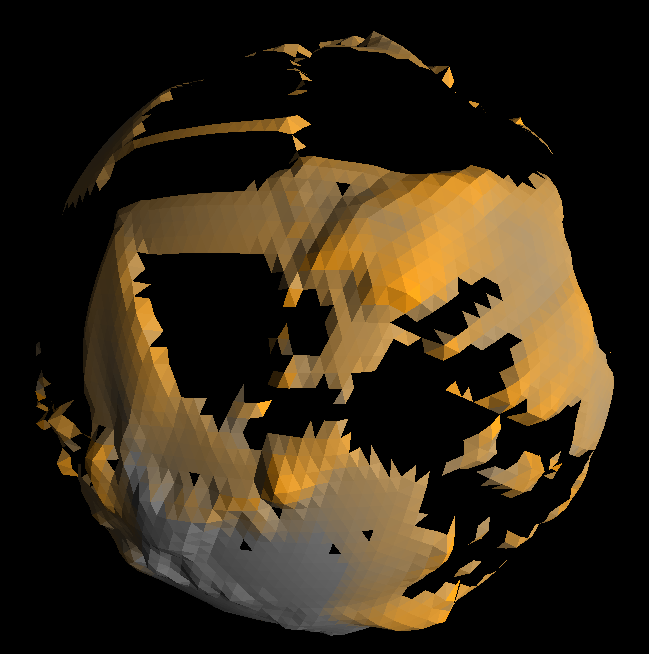
In reality, colder air can hold less water vapor, causing it to condense and fall. The precipitation at each cell will then be a function of its humidity and its temperature. Not much more to say about that, since the relevant part of the generating function is one line of code. Instead, here’s a pretty picture:
Rivers and lakes
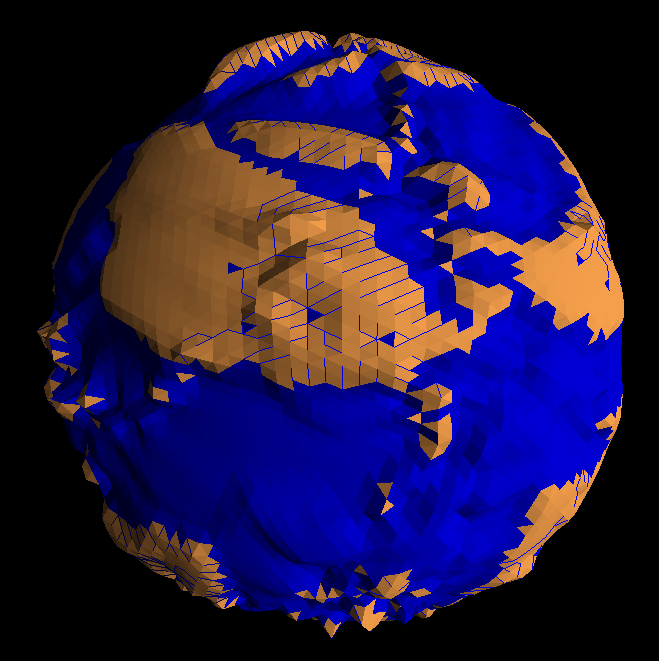
It’s convenient that it rains more at high elevations, since that means long rivers might form. Rivers drain the water of their surrounding cells and the water that’s been dumped on them by other rivers of higher altitudes. They, like on Earth, flow downhill. Duh. Whenever a local minimum in elevation is encountered that doesn’t lead to an ocean, a lake is formed. As the simulation goes on,lakes will provide moisture to areas that could otherwise be dry, making the system a dynamic feedback loop, hopefully one that is interesting to watch.
That does it for climate. Next up, time to make biologists want to yell at me as I implement living creatures.